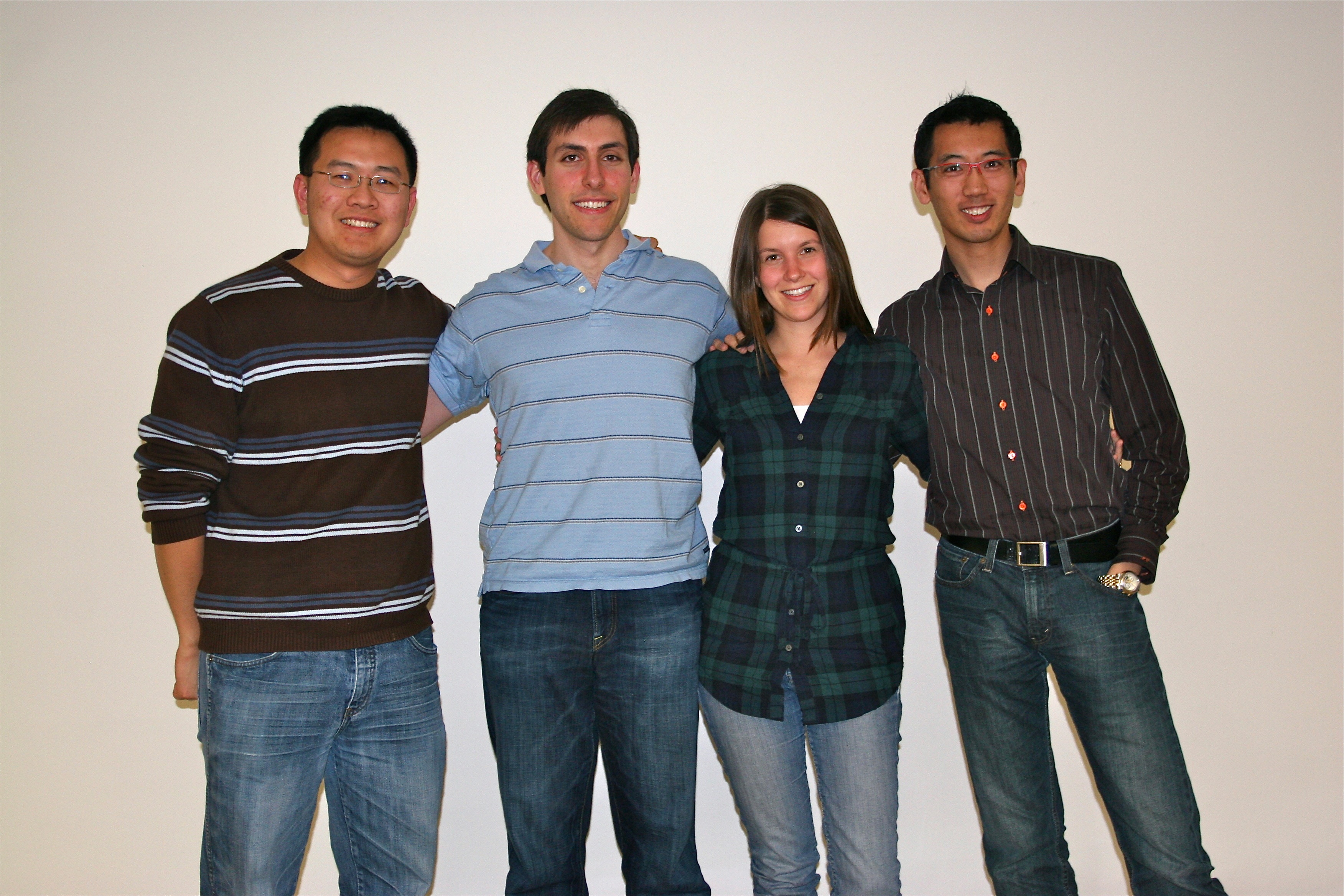
The Lean LaunchPad at Stanford—Class 4: Customer Hypotheses
customer feedback seems to be saying that this product is a “nice to have” versus “got to have.” Is the lack of excitement the MVP? Users? Is this a hobby or a business?
Agora Cloud Services
The Agora team started the week wondering whether they were 1) a true marketplace for cloud computing, where they provide both matching and exchange capabilities for real-time trading. Or were they 2) an information exchange, providing matching services for cloud computing buyers and sellers, providing matching services.
They began with a set of questions:
What are our new hypothesized value propositions?
Which segments have we identified and which do we want to narrow in on?
Which value added services do public clouds want to attract customers for?
Is there a certain segment of buyers that continually makes purchasing decisions (as opposed to only once at the very beginning of a company).
How can we attract buyers to our channel before they make purchasing decisions?
Longer-term work/planning: what other experiments should we be constructing
They had 16 interviews with target customers (Zynga, Yahoo, VMware, Walmart, Zeconder, etc.) as well as channel partners and cloud industry technology consultants.
Agora was in a classic two-sided market (having both buyers and sellers. The Business Model Canvas is a great way to diagram it out. Each side of a market has it’s own Value Proposition, Customer Segment and Revenue Model.) They learned that one their core customer hypothesis about their buyers, “startups would want to buy computing capacity on a “spot market” was wrong. Startups were actually happy with Amazon Web Services. The Agora team was beginning to believe that perhaps their ideal buyers are the companies that have to handle variable and unpredictable workloads.
The Agora team left the week thinking that it was time for a Pivot: find cloud buyers and sellers who need to better predict demand. Perhaps in market segment: medium-large companies that do 3D modeling and life sciences simulations
The feedback from the teaching team “great Pivot” and very clear Lessons Learned presentation. Keep at it.
(For the teaching team one of the most important ways to track the teams progress was through the weekly blogs we made each team keep. This of this as their on-line diary. They hated doing it, but for us it added a window into their thinking process, allowed us to monitor how much work they were doing, and more importantly let us course correct when needed.
BTW, If I was on the board of a startup with a first time CEO I might even consider asking for this in the first year as they went through Customer Discovery. Yes it takes time, but I bet it’s less than time than you would spend having coffee with an advisor each week.)
A prolific educator, thought leader and writer on Customer Development for Startups, Steve Blank is a retired serial entrepreneur who teaches, refines, writes and blogs on “Customer Development,” a rigorous methodology he developed to bring the “scientific method” to the typically chaotic, seemingly disorganized startup process. Now teaching entrepreneurship at three major universities, Blank co-founded his first of eight startups after several years repairing fighter plane electronics in Thailand during the Vietnam War, followed by several years of defense electronics work for U.S. intelligence agencies in “undisclosed locations.” Four Steps to the Epiphany, Blank’s fast-selling book, details the Customer Development process and is increasingly a “must read” among entrepreneurs, investors, and established companies alike, when the focus is optimizing a startup’s chances for scalability and success.
After 21 years driving 8 high technology startups, today Steve teaches entrepreneurship to both undergraduate and graduate students at U.C. Berkeley’s Haas School of Business, Stanford University’s School of Engineering and the Columbia/Berkeley Joint Executive MBA program. His “Customer Development” teaching and writing coalesce and codify his experiences and observations of entrepreneurs in action, including his own and those he advises. “Once removed from the day-to-day intensity of founding a startup, I was able to observe a pattern that distinguishes successful startups from failures,” Blank says. In 2009, he earned the Stanford University Undergraduate Teaching Award in Management Science and Engineering. The San Jose Mercury News listed him as one of the 10 Influencers in Silicon Valley. In 2010, he was earned the Earl F. Cheit Outstanding Teaching Award at U.C. Berkeley Haas School of Business. Despite these accolades, Steve says he might well have been voted “least likely to succeed” in his New York City high school class.
Steve Blank arrived in Silicon Valley in 1978, as boom times began. His early startups include two semiconductor companies, Zilog and MIPS Computers; Convergent Technologies; a consulting stint for Pixar; a supercomputer firm, Ardent; peripheral supplier, SuperMac; a military intelligence systems supplier, ESL; Rocket Science Games. Steve co-founded startup number eight, E.piphany, in his living room in 1996. In sum: two significant implosions, one massive “dot-com bubble” home run, several “base hits,” and immense learning leading to The Four Steps.
An avid reader in history, technology, and entrepreneurship who seldom cracks a novel, Steve has followed his curiosity about why entrepreneurship blossomed in Silicon Valley while stillborn elsewhere. It has made him an unofficial expert and frequent speaker on “The Secret History of Silicon Valley.”
Steve’s interest in combining conservation with best business practices had Governor Arnold Schwarzenegger appoint him a Commissioner of the California Coastal Commission, the public body which regulates land use and public access on the California coast. He also serves on the Expert Advisory Panel for the California Ocean Protection Council. Steve serves on the board of Audubon California, was its past chair, and spent several years on the Audubon National Board. A board member of Peninsula Open Space Land Trust (POST), Blank recently became a trustee of U.C. Santa Cruz and a Director of the California League of Conservation Voters (CLCV). Steve’s proudest startups are daughters Katie and Sara, co-developed with wife Alison Elliott. The Blanks live in Silicon Valley.
View all posts by Steve Blank